
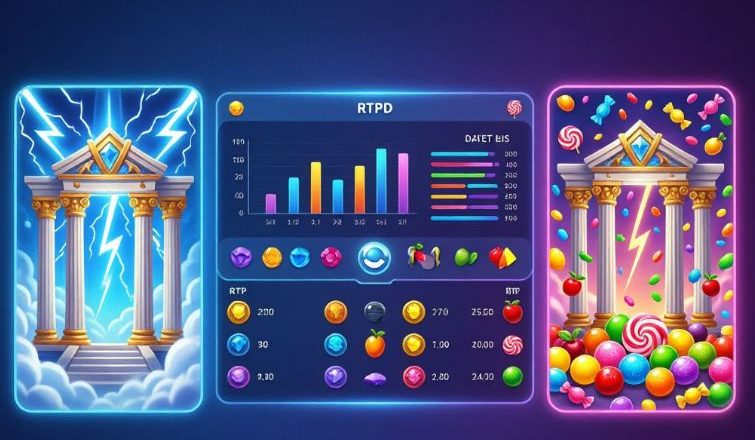
Walk into any modern online casino, and two vibrant thumbnails will inevitably catch your eye: one featuring a stern, glowing-eyed Greek god hovering amidst marble pillars, and the other showcasing a whimsical landscape made entirely of ice cream and candy canes. Both masterpieces emerged from the creative studios of Pragmatic Play, fundamentally rewriting the rules of what a modern slot machine could be. While they share a common lineage and engine, they offer vastly different psychological and financial experiences for players seeking their next big thrill.
The engine under the hood
To understand why these games became global sensations, we must look at how they broke away from traditional spinning reels. Instead of hunting for matches along specific horizontal or diagonal paylines, players are introduced to a revolutionary payout mechanism that values quantity over strict positioning.
Both titles utilize a scatter-pay system on a six-reel, five-row grid. Winning combinations occur whenever a certain number of identical symbols appear anywhere on the screen, regardless of where they land. When a win is achieved, the successful symbols shatter and disappear, allowing new ones to cascade down from above in a tumbling action.
This mechanical foundation allows players to experience the thrill of multiple consecutive wins on a single bet. Let us break down the specific gameplay elements that define the moment-to-moment action in both environments:
- The payout threshold: a minimum of eight matching symbols anywhere on the grid is required to trigger a win in both games.
- The tumbling feature: winning symbols are systematically removed, creating a chain reaction where new symbols drop down to fill the empty spaces.
- The scatter trigger: landing four or more scatter symbols, represented by Zeus or a giant lollipop, triggers the lucrative free spins bonus round.
- The ante bet: players can increase their base stake by twenty-five percent to double their natural chances of triggering the bonus feature.
These shared characteristics show how closely related the physical structure of both games truly is. However, the identical core layout is merely a canvas on which the developers painted two entirely different mathematical models, creating unique risk profiles for different types of slot enthusiasts.
Volatility, RTP, and the math of winning
While the visuals may guide your initial choice, the mathematical structure under the hood will ultimately dictate how long your session lasts and what kind of payouts you can expect. This is where the divergence between the sweet paradise and the mountain of the gods becomes stark.
Return to player, commonly referred to as RTP, represents the theoretical percentage of wagered money a game pays back to players over a massive volume of spins. For both of these games, the default RTP sits comfortably around the ninety-six percent mark, which is highly competitive in the modern gaming market. However, casinos often have access to flexible RTP ranges, meaning the exact payout percentage can vary depending on the platform you choose. The real difference lies in the volatility levels, which measure how often and how intensely a game distributes its rewards.
To visualize these hidden mathematical differences clearly, we can compare their core statistics and performance metrics side-by-side.
| Metric | Sweet Bonanza | Gates of Olympus |
|---|---|---|
| Default RTP | 96.48% | 96.50% |
| Volatility rating | Medium to high | High |
| Maximum payout potential | 21,100x the stake | 5,000x the stake |
| Multiplier mechanic | Sticky bomb during free spins | Random global multipliers in both base and bonus |
| Bonus buy cost | 100x the current bet | 100x the current bet |
As the comparative data demonstrates, the sweet-themed game offers a massive maximum payout potential that dwarfs the cap set by the Greek deity. Yet, the divine alternative compensates for this lower cap by making its multiplier mechanics active during the base game, whereas the colorful candy adventure locks its biggest multiplier potential behind the free spins barrier.
Multiplier mechanics and bonus structures
The way multipliers are delivered and accumulated represents the most significant gameplay distinction between these two modern classics. Understanding this mechanic is crucial because it directly influences your session’s emotional highs and lows.
In the candy-filled world, multipliers appear only during the free spins round as colorful bombs containing values ranging from two to one hundred. These multipliers are additive, meaning if you land a two-times bomb and a five-times bomb, your total win for that tumble sequence is multiplied by seven. The catch is that these bombs disappear at the end of each spin, reset to zero, and must be landed anew on the next round.
The ancient Greek setting takes a completely different approach by introducing global, persistent multipliers that can strike at any moment, even during standard base gameplay. When the thunder god raises his hand, winged spheres containing multipliers from two to five hundred descend upon the grid.
This active system completely alters the tension of the game, introducing several key elements that keep players on the edge of their seats:
- Base game multipliers: random multipliers can land during any ordinary spin, meaning massive wins are possible without ever triggering the free spins.
- Global multiplier accumulation: during the free spins bonus, any multiplier that contributes to a winning spin is added to a persistent global counter.
- The additive carryover: subsequent winning spins that feature a new multiplier will apply the sum of the new multiplier and the accumulated global multiplier.
- The dead spin hazard: landing a massive multiplier value is useless if you do not achieve a winning combination of standard symbols on that same spin.
This unique accumulation feature creates a compounding effect that can turn even small wins into monumental payouts as the bonus round progresses. It also means that a player’s focus shifts from simply hunting for matches to desperately praying for a multiplier sphere to land alongside those matches.
Determining your perfect slot matchup
Choosing which game to play ultimately depends on your appetite for risk, your financial goals, and the kind of gameplay experience you find most engaging. Both options represent the pinnacle of modern slot design, but they speak to different types of players.
If you prefer a game where the base spins can suddenly explode with massive wins out of nowhere, the thunderous Greek realm is likely your best destination. The constant threat of random multipliers keeps every single spin exciting, even if the high volatility means you might face longer dry spells. On the other hand, if you enjoy a slightly smoother ride with a legendary maximum jackpot that can reach astronomical levels during the bonus round, the candy-filled paradise will suit you perfectly. Whichever grid you choose to spin, understanding these mechanical differences allows you to play with a clear strategy and realistic expectations.