
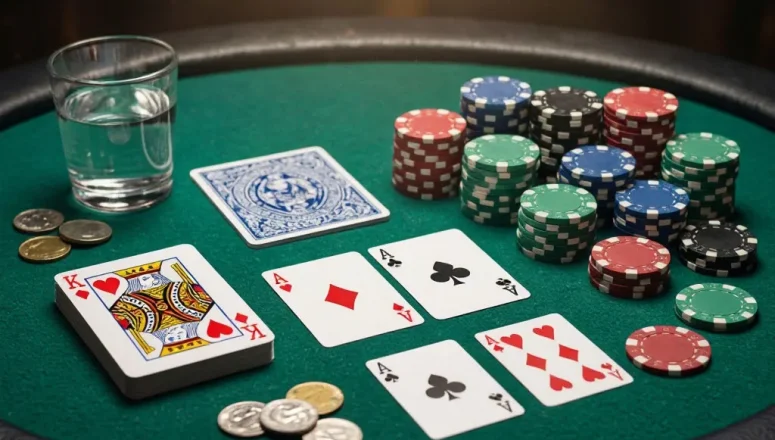

Texas Hold’em looks intimidating from the outside: fast-talking players, chips flying, jargon flying faster. Underneath, the rules fit on a napkin, and the hand rankings can be learned in an evening. The real challenge of a first session is not memorising the mechanics but surviving the decisions, because poker punishes two opposite failures with equal efficiency: playing too many hands and folding too slowly. This guide walks through the complete structure of the game, from blinds to showdown, locks in the hand rankings until they are automatic, and then deals with the part no rules page covers, the predictable mistakes that separate a tolerable first session from an expensive one.
The skeleton of a hand
Every hand of Hold’em follows the same arc, and once the arc is familiar, the game’s rhythm becomes readable. A hand moves through four betting rounds, and the order is fixed:
- The blinds are posted. Before any cards are dealt, the two players to the left of the dealer button post the small blind and the big blind, forced bets that guarantee there is money worth competing for.
- Hole cards are dealt. Each player receives two private cards, face down, known only to them.
- The preflop betting round. Starting with the player to the left of the big blind, each player calls, raises or folds. The big blind has the option to raise even if everyone else just calls.
- The flop. Three community cards are dealt face up in the middle, available to every player, and a second betting round begins with the first active player left of the button.
- The turn. A fourth community card is dealt, followed by another betting round at the same stakes.
- The river. The fifth and final community card is dealt, and the last betting round takes place.
- The showdown. Remaining players reveal their cards, and the best five-card hand wins the pot. In the rare case that all players fold before the river, the last aggressor takes the pot without showing cards.
Two structural points catch beginners immediately. The first is that your two hole cards plus the five community cards give you seven cards from which to make your best five-card hand; you cannot use more than five, and you do not have to use your hole cards at all, which surprises people who have only seen poker in films. The second is position: the player who acts last on each street, closest to the button, sees everyone else’s decision before committing money, and that informational advantage compounds over every hand. Position is the quietest skill in poker and among the most valuable.
The hand rankings, learned once
The rankings are the foundation of every decision, and they reward careful attention to one counterintuitive fact: fewer ways to make a hand means the hand is rarer and stronger. This table runs from strongest to weakest:
| Rank | Hand | Description | Example |
|---|---|---|---|
| 1 | Royal flush | Ace-high straight flush | A♠ K♠ Q♠ J♠ 10♠ |
| 2 | Straight flush | Five consecutive suited cards | 9♦ 8♦ 7♦ 6♦ 5♦ |
| 3 | Four of a kind | Four cards of the same rank | Q♥ Q♦ Q♠ Q♣ 9♣ |
| 4 | Full house | Three of a kind plus a pair | J♥ J♣ J♠ 8♦ 8♣ |
| 5 | Flush | Five cards of the same suit | A♥ J♥ 9♥ 6♥ 3♥ |
| 6 | Straight | Five consecutive ranks, mixed suits | 10♣ 9♦ 8♥ 7♠ 6♣ |
| 7 | Three of a kind | Three cards of the same rank | K♥ K♦ K♠ 7♣ 2♠ |
| 8 | Two pair | Two different pairs | A♣ A♦ 9♥ 9♠ 5♣ |
| 9 | One pair | Two cards of the same rank | 10♥ 10♦ K♠ 7♣ 4♦ |
| 10 | High card | None of the above | A♠ J♥ 8♣ 6♦ 3♠ |
Three clarifications prevent the most common ranking mistakes. A full house beats a flush, which feels wrong to newcomers because a flush looks rarer in a single deal, but full houses are genuinely harder to assemble from seven cards. Suits never break ties in Hold’em; split pots go to both players in full. And the kicker, the highest unpaired card completing your five-card combination, decides ties between equal-ranked hands, which is why an ace with a weak second card plays so much weaker than an ace with a strong one.
Position and the hierarchy of hands you should play
If hand rankings tell you what beats what, position tells you how aggressively you can pursue it. The same starting hand is a raise from the button and a fold from early position, because the information you gain by acting last changes the hand’s profitability. A reasonable beginner’s starting-chart philosophy compresses this into a memorable gradient: play tight from early positions, widen steadily as your position improves, and raise the strongest hands while folding the marginal ones.
This is where the first list of the game earns its keep, the discipline of hand selection. The categories that matter for a beginner’s range:
- Premium hands, including aces, kings, queens and ace-king, which justify raising from any position and re-raising against aggression.
- Strong playable hands, including jacks through nines, big suited connectors and ace-high suited cards, which raise from mid and late position and call selectively from early.
- Speculative hands, including small pairs and suited connectors, which play best from late position where cheap entry and implied odds compensate for their fragility.
- Everything else, which folds. The overwhelming majority of starting hands belong in this category, and the discipline to fold them is the single largest source of beginner savings.
The counterintuitive truth behind this gradient is that playing fewer hands wins more money, not less. Every marginal hand you fold from bad position saves the money that hand would have slowly bled, and the folded hands are invisible savings, while the hands you win with are memorable. That asymmetry is why beginners systematically overestimate how many hands they should play.
Betting actions and what they communicate
Each betting round offers the same four options, and understanding them as information, not just transactions, is the second layer of the game. Calling means matching the current bet; raising means increasing it; folding means surrendering your claim to the pot; and checking passes the action when no bet is pending. The beginner-relevant insight is that bet sizes communicate ranges: large bets usually polarise toward very strong hands or bluffs, while small bets often indicate marginal holdings, and reading these patterns is the first primitive form of reading opponents.
Pot odds deserve a single paragraph because beginners either ignore them or overcomplicate them. When facing a bet, compare the size of the pot plus the bet against the cost of your call; if your chance of improving exceeds that ratio, calling is correct. The practical shortcut, counting the outs, cards that improve your hand, and multiplying by two per street, is accurate enough for a first year of play, and it converts calling decisions from feelings into arithmetic.
First-session mistakes and how they wound a bankroll
Every beginner’s first session produces a highlight reel of the same errors, and recognising them before they happen is worth more than any amount of strategy reading. The most expensive ones, in rough order of damage:
- Playing too many hands. The universal beginner error. Seeing forty percent of flops instead of twenty hands over your bankroll’s ability to survive, and the fix is mechanical: fold the bottom of your range and let the discipline do the work.
- Calling instead of raising with strong hands. Slowplaying premiums lets marginal hands draw profitably, and the fix is aggressive simplicity: raise your best hands, fold the rest, and let aggression carry the load until experience justifies nuance.
- Chasing draws without odds. Calling two streets with a gutshot or a weak flush draw against large bets is the fastest route to a depleted stack, and pot odds arithmetic exists precisely to stop this.
- Overvaluing one pair. Beginners treat top pair as nearly unbeatable and call down every barrel; experienced players fold one pair to heavy aggression on scary boards, and the difference in cost is enormous.
- Tilting after a bad beat. The hand where your set lost to a runner-runner flush feels personal, and the next twenty minutes of loose calls are the real cost of that hand. Standing up after a cooler is not weakness; it is bankroll management.
- Playing stakes too high for the bankroll. A beginner rolling with a hundred units at a stake where one session swings fifty is one bad run from quitting the game entirely.
- Ignoring the action before you. Acting out of turn, calling the wrong amount or letting confusion over the betting structure cause misclicks costs more money than any strategic error on the list.
Not every mistake is fixable in one evening, and the honest expectation is that the first sessions will leak money into specific, identifiable errors rather than into mystery. The encouraging part is that these seven cover the overwhelming majority of a beginner’s losses, and each one has a mechanical fix that requires no advanced theory.
Where to practise before risking anything
The cheapest tuition in poker is play money, and the second cheapest is very low stakes. Free apps and play-money tables let you drill the hand rankings until they are reflexive, and micro-stakes cash games teach the social texture, betting rhythms and table talk that free play never quite replicates. The natural progression is play money until the rankings and actions feel automatic, then micro stakes until basic strategy survives a few hundred hands, then a step up only when the current level feels routine. Home games with friends sit somewhere in between: lower pressure than online micro stakes, higher stakes than play money, and often the most instructive environment of all because the opponents are familiar and the feedback is honest.
Beyond the first session
Poker rewards layered learning: the rules in an evening, solid fundamentals over weeks, and genuine depth over years. The concepts that await beyond a first session, positional awareness as a habit, pot odds as reflex, range thinking that replaces hand thinking, and eventually the aggression frequencies that separate competent players from dangerous ones, all build on the foundation laid here. The first session’s real goal is not winning money but collecting clean data: which mistakes appeared, which hands felt uncomfortable, and which decisions were made by emotion rather than arithmetic. A beginner who leaves the table with that list has already done the hardest part, because the mistakes that cost beginners money are not mysterious; they are predictable, documented and correctable, and correcting them one session at a time is exactly how every strong player started.