
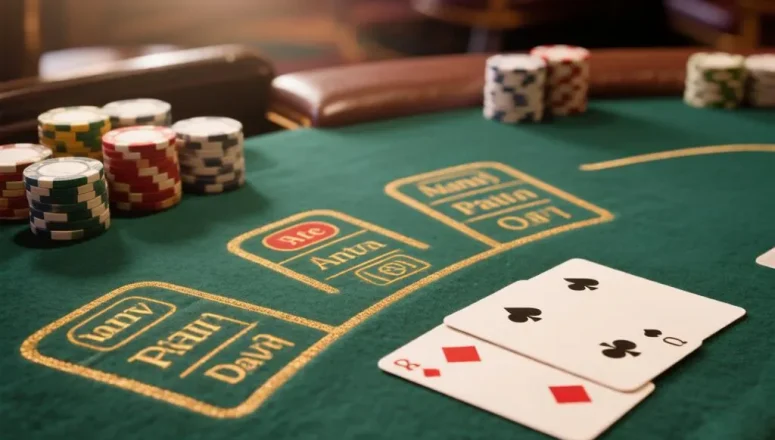

Walk past any casino pit and Three Card Poker is easy to spot: fast hands, quick settlements, and tables where players win or lose in under a minute. It is one of the most successful casino poker inventions ever made, precisely because it strips poker down to a single decision. There are no community cards, no betting rounds, and no opponents to outthink — just your three cards, the dealer’s three cards, and two or three bets you can choose to make. That simplicity hides more depth than most players ever explore, and the differences between the Ante, Play and Pair Plus bets are exactly where that depth lives.
How a round actually unfolds
Every hand follows the same tight sequence, and once you have played it three or four times, the flow becomes automatic. Understanding the order of events also explains why the bets behave the way they do, because each wager is resolved at a different moment in that sequence.
- Place your Ante, and optionally a Pair Plus bet. The Ante is mandatory if you want to see cards at all; Pair Plus is always optional and plays independently of the dealer’s hand.
- Receive three cards face down. The dealer also receives three cards, which remain face down throughout your decision.
- Decide: play or fold. Look at your hand and either fold, surrendering your Ante, or make a second wager — the Play bet — equal to your Ante.
- Reveal and compare. The dealer turns over the cards, and the higher three-card hand wins. If the dealer’s hand is queen-high or better, the hand “qualifies.”
- Settle all bets. The Ante and Play bets are settled against the dealer’s qualifying hand, and the Pair Plus bet is settled purely against your own cards.
Notice the asymmetry built into step four: the dealer has to hold at least queen-high to contest your hand. If the dealer’s cards are worse, your Ante pays automatically and the Play bet pushes, no matter how weak your own hand is. This single rule — the dealer qualification — is what gives Three Card Poker its distinctive strategy and its distinctive house edge.
Hand rankings in the three-card world
Three-card poker uses a shortened version of standard poker rankings, and one counterintuitive change trips up players who know five-card poker well. With only three cards, a flush is harder to make than a straight — three suited cards is rarer than a three-card run — so the flush beats the straight, the reverse of the familiar five-card order. The full ladder from top to bottom runs: straight flush, three of a kind, straight, flush, pair, high card. Aces play high or low in straights, so ace-two-three is a valid run. When two hands tie in rank, the higher cards win; identical ranks are resolved card by card, from highest to lowest.
The Ante bet: the foundation wager
The Ante is your ticket to the game. It pays even money against the dealer’s hand when you win, and it carries an extra sweetener called the Ante bonus: certain strong hands pay a premium even if the dealer wins the hand itself. In the standard version, a straight pays an Ante bonus of 1 to 1, three of a kind pays 4 to 1, and a straight flush pays 5 to 1. This bonus is paid on your Ante alone, in addition to the regular win or loss, which is why occasionally you will lose the hand yet still walk away ahead overall.
The house edge on the combined Ante and Play game runs about 3.4% of the Ante under standard payouts — noticeably higher than blackjack under good rules, low enough to keep the game competitive with most table offerings. What you get for that edge is pace and simplicity: a complete, self-contained decision every half minute.
The queen-six-four rule: the only decision you need
The heart of Three Card Poker strategy fits into four words: play queen-six-four. If your hand is queen-six-four or better, raise with the Play bet; if it is worse, fold. That is the entire optimal strategy for the standard game, and it is not an approximation — mathematicians have verified that this single cutoff loses almost nothing to a perfect strategy that considers every one of the 22,100 possible hands.
The logic behind the number is straightforward. You are risking two units (Ante plus Play) to win one unit back from the Ante, so your hand has to be strong enough to beat a dealer who qualifies often enough to justify the extra bet. A queen with at least a six and a four is the precise tipping point. Hands just below the cutoff — queen-high with low kickers, jack-high, worse — lose more by raising than by folding, while hands just above it earn more by raising. Nothing else about your cards changes the decision, which makes Three Card Poker the rare casino game where optimal play fits on a sticky note.
The Play bet: where the strategy lives
The Play bet is the second, equal-sized wager you post after seeing your cards, and it is where all the decision-making in the game happens. Fold and you lose only the Ante; play and you risk a second unit to contest the dealer’s hand and collect even money on both bets if you win. Because the dealer must qualify with queen-high or better, roughly a third of dealer hands fold automatically — and when the dealer does not qualify, your Ante pays even money and your Play bet pushes back to you, win or lose.
One detail worth internalizing: a folded hand never receives a Pair Plus settlement in most standard versions. If you fold a hand holding a pair, your Pair Plus wager is typically forfeited along with the Ante, even though your cards would have paid. This quirk occasionally produces awkward moments — players holding a pair of twos who convince themselves the hand is too weak to play — and it is exactly the kind of situation the queen-six-four rule exists to prevent. A pair is always above the cutoff, so the correct move is always to play it.
The Pair Plus bet: poker against yourself
Pair Plus ignores the dealer entirely. You are betting one proposition: that your own three cards will contain a pair or better. Win or lose against the dealer’s hand has no effect on this wager — a triumphant straight flush pays you whether the dealer holds a better one or not, and a losing high-card hand forfeits the bet even if the dealer never qualified.
The standard paytable for Pair Plus looks like this, and the frequencies next to each hand explain why the big payouts are so rare:
| Hand | Approximate frequency | Pair Plus payout | Ante bonus payout |
|---|---|---|---|
| Straight flush | 0.22% of hands | 40 to 1 | 5 to 1 |
| Three of a kind | 0.24% of hands | 30 to 1 | 4 to 1 |
| Straight | 3.26% of hands | 6 to 1 | 1 to 1 |
| Flush | 4.96% of hands | 4 to 1 | — |
| Pair | 16.94% of hands | 1 to 1 | — |
The numbers tell the story plainly: nearly a quarter of all hands pay something on Pair Plus — a pair lands about one in six deals — but the hands that carry meaningful payouts arrive a few times per thousand deals. The house edge on standard Pair Plus runs roughly 2.3% to 7%, depending on the exact paytable in force, and the range is wide precisely because casinos adjust the upper payouts. Some venues trim the straight flush to 35 to 1 or the three of a kind to 25 to 1; the losing potential of the bet barely changes, but the edge quietly grows. Checking the paytable card before you put money on that circle is the single most valuable ten seconds you can spend at the table.
Ante, Play or Pair Plus: which bets actually earn their keep
Ranking the three wagers by house edge produces a clear hierarchy, and it settles a debate that comes up at every Three Card Poker table. The combined Ante and Play game, played with the queen-six-four rule, offers the lowest edge of the standard bets. Pair Plus sits slightly higher, and the optional side bets that many casinos attach — Six-Card Bonus, Prime, Progressives — carry edges well above either core bet. A few practical points distinguish how these options behave in real sessions.
- The Ante-Play game has a fixed, proven edge. Roughly 3.4% of the Ante, before the Ante bonus softens it, with no paytable variation to watch for in most venues.
- Pair Plus edges swing with the paytable. The 40-30-6-4-1 structure is standard, but trimmed versions exist, and reading the placard matters more here than anywhere else.
- Six-Card Bonus and similar side bets are lottery tickets. They combine your three cards with the dealer’s three to make a five-card poker hand, pay huge premiums for royal flushes and five-card runs, and carry edges that commonly exceed 8%.
- Pair Plus can be played alone or alongside the Ante. Some players use it exclusively, which turns the game into a pure lottery against your own cards and removes the fold decision entirely.
Side bets deserve their reputation as entertainment purchases rather than strategy plays. They are not wrong to place — the sessions where a Six-Card Bonus pays a five-card straight flush are memorable precisely because they are rare — but budgeting them as optional spice, rather than as part of your core bet, is what keeps them from quietly doubling the cost of an evening.
Where the game goes from there
The success of the original has produced a family of variants, most of which tweak the qualification rule or add card-count mechanics. Some versions let you raise twice your Ante, others remove the dealer qualification altogether in exchange for a different paytable, and a handful introduce shared community cards. The fundamentals above survive every variant: three cards each, one fold-or-play decision, and one independent side bet. If you know the standard game, you can sit down at any descendant of it and find your footing within a few hands.
Practical pointers before your first hand
A short session plan turns everything above into behavior, and Three Card Poker rewards preparation more than most games its size. Before your first wager, it helps to settle these points.
- Confirm the paytables at your table. Both the Pair Plus payouts and the Ante bonus schedule can vary; the placard at the table shows the exact numbers in force.
- Memorize the cutoff. Queen-six-four or better, play; otherwise fold. There are no exceptions, and second-guessing the rule is the most expensive habit at the table.
- Decide your Pair Plus budget separately. Treat it as its own allocation, sized so that a long run of non-paying hands never pressures your Ante-Play bankroll.
- Sit out sidelines until the core game feels automatic. The fold decision is quick but easy to rush; adding side bets before the rhythm is natural increases mistake rates.
The payoff for this preparation is real but quiet: Three Card Poker played near-optimal strategy costs only a few cents per hour more than the theoretical minimum, while the same game played on instinct can cost several times that. It is one of the few casino games where the knowledge gap between an informed player and an uninformed one is so compressed into a single decision — and where making that decision correctly takes almost no effort at all.
The bottom line
Three Card Poker compresses a full poker experience into one decision and two or three bets. The Ante buys you into the hand, the Play bet is your fold-or-raise judgment, and the Pair Plus circle is a separate bet on your own cards against a fixed paytable. The queen-six-four rule resolves the judgment perfectly, the dealer’s queen-high qualification creates the game’s texture, and the paytable — especially on Pair Plus — is the one thing worth reading before the cards fly. Learn the rankings, memorize the cutoff, size your side bets deliberately, and the fastest game in the pit becomes one of the easiest to play correctly.