
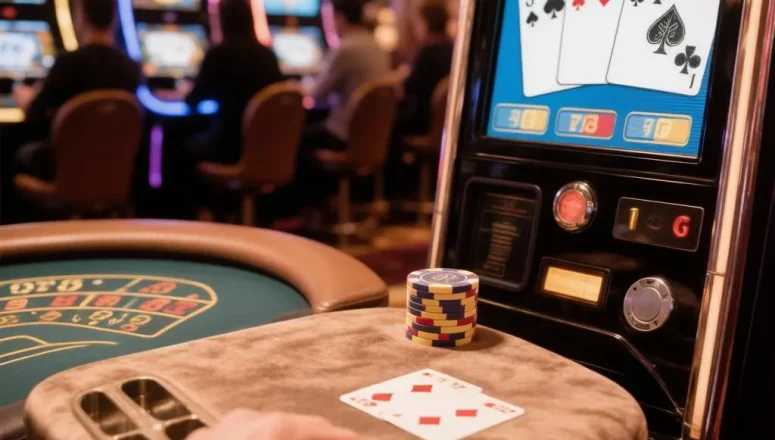

Every casino game publishes its price somewhere, and most players never look. The slot does not even offer the option — its return is a locked number you accept by pressing spin. Table games fare slightly better, but their edges are fixed by rules no player can influence. Video poker is the outlier in the entire building: its return is published on the glass, in plain numbers, in the form of a paytable — and with the right paytable plus correct decisions, that published number climbs all the way to 99.5%, leaving the house with less than half of one percent to live on.
That figure is not marketing. Full-pay Jacks or Better — the 9/6 version, named for its 9-for-1 full house and 6-for-1 flush payouts — genuinely returns 99.54% under optimal play, which has been verified by decades of computer analysis over every possible hand. The remaining gap between 99.54% and 100% is small enough that a skilled player wins often, loses slowly and survives variance that would destroy them at any table game. But the number comes with conditions attached, and both conditions — the right machine and the right decisions — are the subject of everything that follows.
Why video poker can be beaten this close to even
The 99.5% figure becomes explicable once you see where the player’s decisions fit into the math. Each hand begins as a five-card deal from a standard 52-card deck, and the deal itself is pure chance — nothing to influence there. But then comes the draw: the player chooses which cards to hold and which to discard, and that single choice is made among 32 possible hold patterns for every dealt hand. For each pattern, the probability of every final hand can be calculated exactly, and multiplying those probabilities by the paytable’s payouts produces the expected value of each option.
The best hold is the one with the highest expected value, and making that choice consistently is what optimal strategy means. The numbers behind the guarantee are these:
- 2,598,960 possible starting hands — every one of them has been analyzed, and the optimal hold for each has been mapped into a strategy the human brain can execute;
- 32 hold-discard combinations per hand — most players consider three or four options; the difference between their choice and the best one is often a fraction of a percent per hand that compounds relentlessly;
- A 0.46% house edge under perfect play — wagering a dollar per hand, the expected long-term cost is under half a cent; the same dollar on roulette costs about 2.7 cents, and on a typical slot, four to eight cents;
- Errors are the only real price — the paytable does not change, the shuffle does not change; every percent of return lost to imperfect play is chosen, one hand at a time, by the player.
This is why video poker occupies its strange position in the casino: the machine is honest, the return is published, and the margin between the game and pure fairness is thinner than anywhere else on the floor. The price of admission to that margin is skill — and skill here is a learnable, finite, completely mapped body of knowledge, not an intuition.
The 9/6 paytable: the machine worth finding
Optimal strategy presupposes an optimal machine, and the paytable is where that quality is decided. The famous 9/6 label refers to two payouts: full house paying 9 coins per coin bet, and flush paying 6. Versions with reduced payouts — 8/5, 7/5, 6/5 — look nearly identical on the floor and differ enormously in return. The comparison between common variants makes the stakes visible:
| Payout difference | Full house pays | Flush pays | RTP with optimal play | Long-term cost per $1 wagered |
|---|---|---|---|---|
| Full-pay machine | 9 | 6 | 99.54% | $0.0046 |
| Slightly reduced | 9 | 5 | 98.45% | $0.0155 |
| Common reduction | 8 | 5 | 97.30% | $0.0270 |
| Heavily reduced | 7 | 5 | 96.15% | $0.0385 |
| Worst floor versions | 6 | 5 | 95.00% | $0.0500 |
The table’s lesson is brutal in its simplicity: the difference between the best and worst machines is more than ten times the entire house edge of full-pay Jacks or Better. A player who finds the 9/6 machine and plays it perfectly loses forty-six cents per hundred dollars wagered; the same player, same skill, on a 6/5 machine five feet away loses five dollars over the same volume. No strategic refinement can compensate for a bad paytable — the machine selection happens before the first hand and outweighs every decision afterward combined.
The strategy core: a hierarchy, not a feeling
The beauty of Jacks or Better is that its optimal strategy compresses into a ranked checklist that a human can memorize and execute. The list works by priority: scan from the top down, hold the first category that matches your hand, and discard everything else. The essential hierarchy, covering the decisions that occur in the overwhelming majority of hands, reads as follows:
- Royal flush, straight flush and four of a kind — always hold a made hand this strong, no exceptions;
- Four to a royal flush — even against made paying hands like a flush, the royal draw’s expected value usually wins, because of the 800-for-1 top prize;
- Three of a kind, straight, flush — hold these made hands unless the four-to-a-royal situation above applies;
- Two pair — hold both pairs; breaking two pair for a four-card draw is a classic and expensive beginner error;
- High pair (jacks or better) — hold the pair; the guaranteed paying hand beats most draws;
- Four to a flush, three to a royal flush — flush draws outrank these, but a suited ten-jack-queen is worth more than it looks;
- Low pair (tens and below) — hold it over most draws; its improvement potential is undervalued by beginners;
- Four to an outside straight — an open-ended straight draw is playable; an inside straight draw with no high cards is never worth holding;
- Two suited high cards down to one high card — hold as many high cards as the hand offers, preferring suited combinations;
- Nothing worth holding — discard all five; the temptation to “keep one alive” is the most common error in the entire game.
Two entries on this list generate most of the money lost by average players. The first is the low pair: players raised on slot logic discard tens or nines in favor of chasing straights, when the pair’s expected value quietly beats the draw. The second is the four-to-a-royal: the instinct to hold a made flush feels safe, but the royal draw’s expected value — powered by the enormous top payout — outweighs the certain flush in the standard 9/6 paytable. Both cases illustrate the same principle: strategy is arithmetic, not comfort, and the numbers favor decisions that feel aggressive.
Why “jacks or better” matters to the strategy
The game’s minimum paying hand — a pair of jacks — is not decoration; it anchors the entire return structure. Roughly 45% of dealt hands contain a pair of jacks or better or a hand that improves to one, which means the game pays something on nearly half of all plays. This high hit frequency is what keeps the variance manageable and the bankroll alive: even during losing stretches, money flows back in the form of small paying hands, and the session’s rhythm feels closer to breaking even than most casino games ever allow.
That rhythm is also what makes perfect play sustainable. A game with punishing volatility tempts players into superstition and improvisation; Jacks or Better’s steady cadence lets a disciplined player execute the same hierarchy for hours without emotional drift. The strategy’s demands are consistent with the game’s temperament — both are built for patience, and both reward it measurably.
From 99.54% theory to practice: where the return actually leaks
The published RTP assumes every hand is played at the highest expected value, and no human achieves that without preparation. The practical leaks between theory and a real session follow recognizable patterns:
- Machine selection errors — playing a reduced-paytable version out of convenience is the largest and most common leak, worth several full percentage points on its own;
- Hierarchy mistakes on borderline hands — the low pair versus four-flush decision, the suited connectors versus low pair, and the discard-everything hands are where the average player surrenders most of their edge;
- Coin level mistakes — many machines boost the royal flush payout from 250-for-1 to 800-for-1 only at maximum coins, and playing below maximum quietly cuts the overall return by over a percentage point;
- Fatigue drift — the strategy is exact, and tired players begin approximating it; session length limits protect the return as much as knowledge does;
- Payout-schedule unawareness across variants — bonus versions of the game (Bonus Poker, Double Double) alter the four-of-a-kind payouts and require their own modified hierarchies; playing generic strategy across altered paytables leaks real money.
The third point is the quietest and most consequential for casual players. The single-coin royal of 250-for-1 is a decoy: the machine’s displayed RTP of 99.5% assumes maximum coins, and the player betting one coin per hand on a machine with a boosted royal is effectively playing a 98% game. Inserting the maximum coins — or choosing a denomination that makes maximum coins affordable — is part of the strategy, not separate from it.
The practice path to perfect play
Reaching the level where 99.5% is realistic is a defined, achievable process, and it follows a natural sequence:
- Learn the full hierarchy, then drill it — trainer software and strategy cards accelerate the process from months to weeks, and the drills concentrate on the borderline hands where errors cluster;
- Play for accuracy before speed — a slow, correct player earns more than a fast, approximate one; speed arrives naturally with repetition;
- Verify every machine’s paytable before sitting — the ten-second inspection is the highest-return habit in the genre, worth more than hours of strategy study;
- Track sessions against expectations — at 99.54%, the expected loss over ten thousand $1 hands is about $46; sessions far worse than that indicate machine problems or strategy leaks, both worth diagnosing;
- Treat comps and promotions as return boosters — since the base game loses so little, loyalty benefits and cashback can push the combined return above 100% for the disciplined player, which is precisely why casinos track video poker players so carefully.
The fifth point hints at the genre’s endgame. Players who combine full-pay machines, perfect strategy and well-timed promotions occupy a position no other casino game offers: close enough to break-even that the house’s own generosity tips the scales. This is also why full-pay machines grow rarer — the industry learned long ago where the thin margins live.
The game that publishes its price
Jacks or Better’s 99.5% return is not a loophole, a rumor or a lucky configuration — it is the honest price of a game whose edge depends on the player’s own execution. The paytable tells you everything: which machine to sit at, which holds to make, and how much each deviation from perfect play costs. No other product on the casino floor extends that level of transparency, and the players who use it occupy a different relationship with gambling than everyone else in the room — one where knowledge converts to money with almost no friction.
The honest framing of that relationship matters as much as the math. Even at 99.54%, the house edge exists, variance remains real, and sessions can lose money for weeks before the long run asserts itself. What the number actually promises is proximity: a game where skill is respected, mistakes are measurable, and the distance between good play and perfect play is a few tenths of a percent rather than a chasm. For the player willing to learn a hierarchy, read a paytable and bet the max coins, Jacks or Better remains what it has been for decades — the fairest fight in the building, and the closest thing to a game where knowing more genuinely means losing less.